The Fastest Way To Transform
I have had the opportunity to work with some of the highest performers in the world – in sport, in business, and in life. The single greatest lesson I’ve learned from these high achievers is this:
Personal development and professional transformation are not magic. Success is the result of a good system executed over time.
As a dear friend continually reminds me, what we need is “a systematic approach of calculated action that gives you consistent and forecastable results.”
The Essential
“It is vain to do with more what can be done with less.” – William of Occam
On this quest for a good system, we would be wise not to complicate things. Let’s focus on what’s essential and remove the rest. We need to make our process of personal transformation simple.
Simple does not mean easy, however. Anything worthwhile takes time, effort, and sacrifice. But it doesn’t have to be complicated, either.
We should be able to explain our system to a 4-year-old. A small child’s ability to entertain our plan is a good predictor for our ability to maintain that plan, and therefore, a decent proxy for future success.
The Transformation Triangle
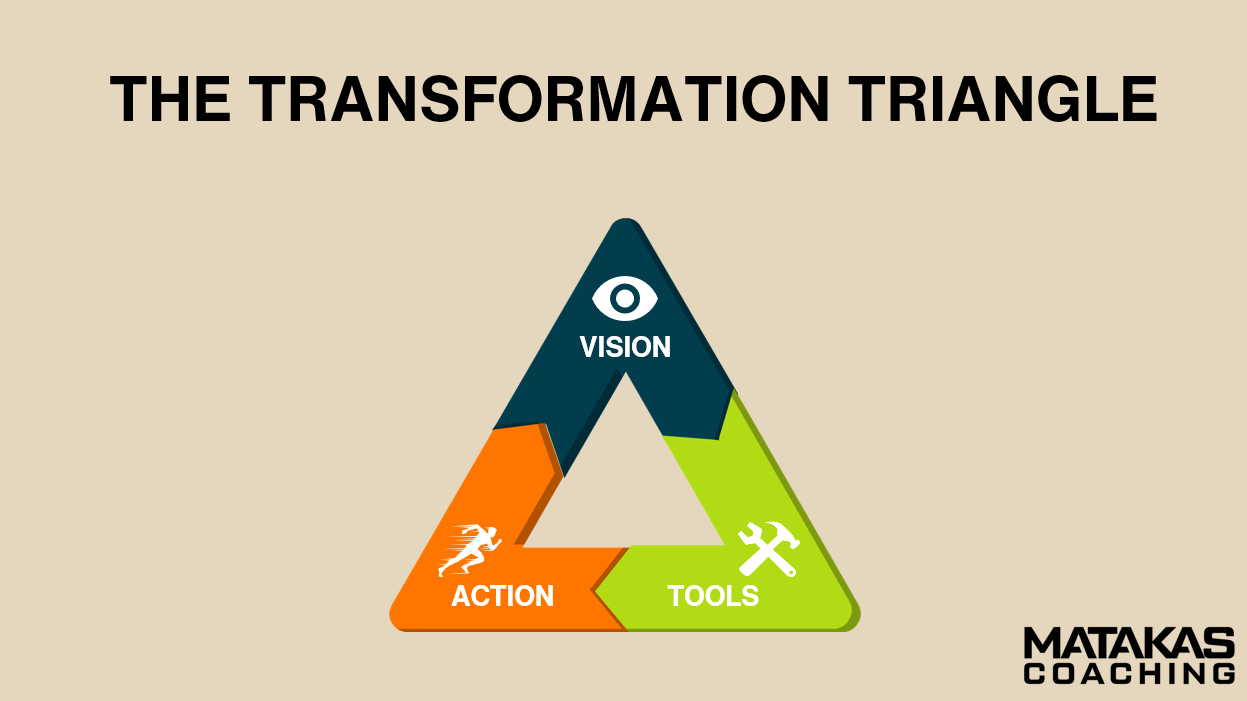
I have used this simple model in my own life, and with the high performers I have served, with repeated success. Our successful transformation requires three things: vision, tools, and action.
The proper vision gives us the clarity that allows for effective and efficient action. We will no longer wander aimlessly or engage in behaviors that don’t create results. The right tools are the skills and abilities that our transformation requires, which makes our future actions worthwhile. And we need to take proper action, because without the right actions, nothing gets done.
This is very, very simple. It’s also incredibly effective.
Syntax Matters
We must get these three right, and order matters.
Clear vision will prevent us from wandering aimlessly, taking the wrong actions, and getting paralyzed by endless possibilities. Clear vision is the map by which we navigate the terrain.
With this clear vision, now on the path to success, we are able to go acquire the particular tools that our journey requires. These are the skills, abilities, and understandings that the future version of us will have which we do not currently possess. We acquire these tools along the way and become that next version of ourselves.
Now, with the vision set and tools at hand, we can engage in the actions that have the highest return on investment, creating the most meaningful change.
Vision leads to tools. The tools make actions worthwhile. Actions achieve the goal.
Order matters. So, let’s start with vision.
Vision
Vision begins with an understanding of the identity one must have to achieve the goal, upgrading our sense of self to become someone for whom this future goal is inevitable, not just a hope.
With this understanding of self, then we get clarity on the problem. We must clearly define the goal with as much specificity as possible. The greatest benefit of this clarity is that with the goal defined, our journey toward that goal increases in simplicity. We will encounter many things on this journey, and now they can all be classified into three categories:
Tools – that which aid the goal
Obstacles – that which impede the goal
Irrelevances – that which doesn’t matter.
With the goal clearly defined, we have a simple decision-making filter for accessing variables on the path. To quote the great Niel Gaiman, now we can simply ask:
“Does this take me towards or away from the mountain?”
With knowledge of our identity, and the specifics of our immediate goal, we can now zoom out to gain an understanding of the role this goal plays in the over-arching development of our continued transformation. There’s an expression I love:
“That which you most need is to be found where you least want to look”.
When we develop the proper perspective, we can see how the “problem” before us is actually a gift – the necessary friction that elicits the growth which is our birthright to attain. This understanding allows us to confront life’s challenges in the most beneficial way.
This clarity creates radical acceptance of one’s circumstances, thus minimizing the internal resistance we generate relative to the challenge. This freedom from internal resistance maintains our resourcefulness as we engage with the natural external resistance any worthwhile challenge provides.
Tools
The person you will be when you achieve this goal has skills, abilities, or understandings that you do not currently possess. To become that version of you, you must acquire these along the way.
There are two types of tools your transformation will require: the pragmatic and the psychological.
The pragmatic are the specific tools that your journey requires. For whom the goal is physical transformation, this is the scale, the app that tracks calories, and the home gym. For whom the goal is business growth, this is the CRM, the sales scripts, and the referral program.
These are straight forward, and these tools are specific to your journey. Everyone reading this will require different pragmatic tools based on their goals. The second set of tools, however, are universal. Every goal, no matter the vision, will require the initiate to have a psychological toolbox that personal transformation requires.
These psychological tools are wide-ranging. Describing these here is beyond the scope of this article, as each tool will receive a separate explanation soon. For now, we should understand that just as we upgrade our skillsets in the world, we must upgrade our own minds, as well.
Once we acquire the tools the journey requires, all that’s left is to take massive and calculated action.
Action
Let’s revisit the wise words from a dear friend:
“a systematic approach of calculated action that gives you consistent and forecastable results.”
Here’s the simplest and effective system of action, requiring just four steps:
1. Stop taking the actions which impede the goal
2. Prioritize the actions which create the highest ROI
3. Condition these actions so they become automatic
4. Audit these actions weekly
We are complicated creatures, often acting at cross purposes to ourselves. Jordan Peterson has a great form of “prayer”:
“If you want to know something about yourself, sit on your bed one night and say, ‘What's one thing I'm doing wrong, that I know I'm doing wrong? That I could fix. That I would fix’. You meditate on that, and you'll get an answer. It won't be one you want. But it'll be necessary.”
The first step to taking great action is to stop taking actions that aren’t great. The second step is to replace them with the actions that have the highest return on investment. There are many frames for this, so here’s a simple one: honor the 80/20 rule.
The 80/20 rule states that 80% of desired outcomes comes from 20% of the actions you take. Prioritize that 20% to efficiently maximize the value you can create.
Once we are engaging in actions that are productive, now they must become constants. Here’s a simple trick: put them in your calendar.
Throw out the To-do list, skipping the middleman, and just put those actions directly into your calendar to ensure they have the space they deserve. Then honor Parkinson’s law: work will expand to fill the time allotted for its completion.
So give the task time, but not too much time. You’d be shocked at how effective this is.
Put the highest ROI actions in your calendar. Honor that time. Commit to fulfilling the task in the time allotted. Sit down once a week to map out the next week’s calendar.
For myself and the clients I serve, this has been a fruitful systematic approach of calculated action that gives consistent and forecastable results.
Assessing Your Transformation Triangle
I gave a workshop recently on using the transformation triangle to create meaningful change. What we discovered was that nearly all participants were thriving in two of the categories while falling short in a third.
Some had clear vision and the right tools but were taking no action. Others had clear vision and were taking action, but they didn’t have the tools that made their actions worthwhile.
Understanding how you are performing with your own transformation triangle can accelerate your efforts in creating positive transformation. Here are some good questions to ask:
Who do I have to become to achieve this goal? How is that version of me different than who I am today?
Have I defined my goal so clearly that I can use the goal as a simple decision-making filter?
Why am I experiencing this challenge? How is this actually a gift for my continued development?
What are the specific skills, abilities, and understandings that my transformation requires which I do not currently possess?
Where can I find these skills, abilities, and understandings?
Does my current belief system aid or impede my achieving this goal?
Have I gotten enough leverage on myself where this change must happen, and it must happen now?
What are the actions I am consistently taking that impede the goal?
What are the actions I can take that have the highest returns on my time, energy, and attention?
Have I put these actions in my calendar?
Do I honor that time appropriately?
When was the last time I took a step back and assessed if what I do each week is really moving me forward toward my goals?
Conclusion
All the above questions deserve their own article, which I will write over the coming months. For now, I leave you with this.
Personal development and professional transformation are not magic. Our success is the result of a good system properly enacted.
Here's the good news: most people are a clear vision, a couple of tools, and a couple of consistent, meaningful actions away from creating the transformation they seek.
“Life punishes the vague wish and rewards the specific ask.” – Tim Ferriss
Look at your own transformation triangle. Ask specific questions. Assess where your greatest opportunities for improvement are. I think you’ll find you are way closer to your goals than you think.
More to come soon, friends.
P.S. Wondering what to the Transformation Triangle at? Here's a simple framework for well-rounded success: The Big Four.
First published January 26, 2024.
Work with Chris
Ready to put this into practice?
Chris coaches small business owners and community leaders one-on-one for 12 weeks toward the goals that matter most.
Read next
Improve
Grow as if Your Life Depends on It
Personal development off the mat. Chris's one book written entirely about life outside Jiu Jitsu.
Get it on Amazon