Jiu Jitsu And Identity
I hope this finds you well! I’ve had some wonderful conversations with students in our academy about Jiu Jitsu and identity. I believe our understanding of how we relate to Jiu Jitsu determines its worthwhileness in our lives.
Below is a chapter from my new book, Jiu Jitsu and The Ego, that describes one of the biggest traps Jiu Jitsu players fall into that robs them of not only progress, but something far more important: joy.
Give it a read and question how this relates to your experience. May this be a fruitful exercise!
Identity
I believe in synchronicities. Partly because I’ve never found anything in the works of Carl Jung that I can effectively argue against. More practically, however, because when I am writing these books, there always seems to be a beautiful marriage of fate and timing in which the happenings of my life coincide with the topic discussed.
It’s Thursday morning, January 20, 2022, and I am where I always am at this hour: writing at my computer. I intended to wrap up this book this morning, but I didn’t see a clear pathway forward. How does one end the beginning of a conversation?
The fates are kind. Less than twenty-four hours prior, during a mindset coaching session with a client, this beautiful soul shared with me a crisis of conscience. He recognized that he had developed a persona as “the Jiu Jitsu guy.” (Something foreign to each of us, I’m sure.)
While always wearing a Jiu Jitsu t-shirt or hat, he led with this identity in social settings, much in the same way he brandished his military swag upon ending his enlistment. Regardless of the setting, he always found a way to direct the conversation toward his experiences in Jiu Jitsu.
Now this is one of the most successful men I have ever met -- in business, family, and the religious life -- and with a panoply of respectable identities to choose from, he found himself settling proudly into the role of “the Jiu Jitsu guy.”
Deep in retreat over a long weekend, a clear message came to him from the void: it’s time to put down this false persona. You do Jiu Jitsu, but you are not Jiu Jitsu.
He experienced what any of us feel in the periods of psychological dissolution: fear, and a sense of depression – of having lost something once found. When we peel back the onion, we discard what has been peeled. In the creation of something new, something old must be lost.
Following the archetypes of transformation, he had experienced a death and rebirth. A death of a definition of self which was incomplete, and a birth into a new experience of identity, closer approximating the truth. The wisdom of his experience highlights our own.
We do Jiu Jitsu. We practice Jiu Jitsu. But we are not Jiu Jitsu. We are so much more than this. We are the ocean manifested in a drop, the culmination of 4.5 billion years of life on this earth, the most complicated, divine, and beautiful being in all of creation. Through this lens, doesn’t it seem like we are selling ourselves short if our first layer of identity is based in Jiu Jitsu?
There’s a trend I’ve noticed among our community. Nearly all the Jiu Jitsu tattoos are drawn onto white belts, while most of the best Jiu Jitsu players I know rarely discuss Jiu Jitsu in conversation. What is to be made of this chasm? Is it wrong to identify as a Jiu Jitsu guy?
Absolutely not. It’s both pertinent and necessary. It is a gift. But much like my friend this week realized, while it’s a respectable identity to adopt for a season of life, it’s not who we are in our essence. There is a deeper identity to be had.
Consider David Foster Wallace’s commencement address, “This is Water”:
“Because here’s something else that’s weird but true: in the day-to-day trenches of adult life, there is actually no such thing as atheism. There is no such thing as not worshiping. Everybody worships. The only choice we get is what to worship … Worship your body and beauty and sexual allure and you will always feel ugly. And when time and age start showing, you will die a million deaths before they finally grieve you.”
I’ve spent 13 books praising the benefits of Jiu Jitsu. It’s time to acknowledge the traps.
If you worship being a Jiu Jitsu player, you will die a million deaths before they finally grieve you. Every time you “lose” a round, every time you get bested, you will experience an overwhelming sense of not being enough. I speak from experience. Nearly all the bad days in my twenties were a result of something silly like getting my guard passed.
I identified my innermost being as a Jiu Jitsu player, and my self-worth was contingent upon my performance in the art. When things went well, I was high. When things went poorly, I experienced painful lows.
This is exhausting. To have your sense of self-worth tied to something as variable as the outcome of your rolls seems undeniably foolish. Especially considering that the road to mastery is to voluntarily seek out your insufficiency. This is a pathway through trial, failure, and adaptation. To continually grow is to live in the state of being just outside your comfort zone, which means, to perpetually “fail” today so that you can win long-term.
That’s the paradox. If you evaluate your worth through Jiu Jitsu first, then by being the best martial artist you can be through the voluntary pursuit of failure, you are going to daily experience the shame of falling short. Your pursuit of a respectable identity through Jiu Jitsu becomes the very act which robs you of the fruits of such an identity. This framework is a trap.
If you are succeeding as a true martial artist, you are losing in mental health. If you prioritize mental health, valuing today’s wins over tomorrow’s growth, you fail as a martial artist. It’s a broken model that must ultimately be transcended if you are to achieve any real progress in either.
The bad black belt applauds his daily success as he stays in comfort zones, completely failing to be the martial artist he goes to great lengths to convince the world he is.
This archetype reveals the fallacy of the position. At this level of consciousness, one cannot achieve success as a martial artist and a person. Our false definitions fragment our psyche, and the only result is confusion, regardless of how good our sweeps get.
We must bring a level of consciousness to our practice uncommon in daily life. For if we don’t, we fall into the trap that all the great mystics have described. We mistake the vehicle for the passenger. We mistake the road for the destination.
All disciplines must ultimately be transcended. The raft which takes you from one shore to the next must be left behind if we are to step foot on that shore. It does not matter how beautiful the raft is, or how skillfully you navigated the open seas, reality is fixed so that the only way to step on the island is to step off the raft.
The same holds true for Jiu Jitsu. If we are to use Jiu Jitsu as a vehicle for personal development, we must not mistake this vehicle for the person. At the very least, we must not prioritize the vehicle over the person. Jiu Jitsu is an unrivaled vehicle for personal development. The question that we must keep in the forefront of our consciousness, it seems, is this:
Is the vehicle taking us where we wish to go?
Here is the link to continue reading: Jiu Jitsu and The Ego.
Wishing you a great week of mindfulness and training,
Chris Matakas
First published July 13, 2022.
Work with Chris
Ready to put this into practice?
Chris coaches small business owners and community leaders one-on-one for 12 weeks toward the goals that matter most.
Read next
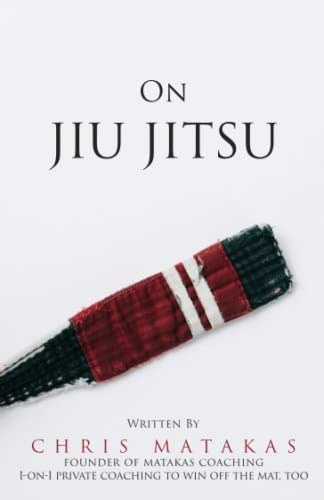
On Jiu Jitsu
How training shapes character, read through the lens of virtue and vice. The most read of Chris's books after 5 Rules.
Get it on Amazon